


CREATIVITY
is a skill

As the young, hip creative that you are, you probably jump at the chance to work on any assignment that doesn’t have to do with MLA citations or T-I84 calculators. While that ball of creative energy is a great tool, it can often times lead you to rush into a project that lacks any meaningful direction or concept. That, my creative friend, is where design thinking comes in handy.
DESIGN THINKING
what are that?
There are countless books and Ted Talks that delve deep into the inner workings of design thinking, but I’m here to offer you the Reader’s Digest version. It’s essentially a creative process that focuses on the human-centered aspects of design.
What problem is the user facing?
How does your design make the user feel?
What does a solution really look like for the user?
If the word “user” is tripping you up, simply design with the human receiving your designs in mind. Another key aspect of design thinking to remember is that these five phases are just phases, not steps. This process is not at all linear. You will jump around from phase to phase multiple times until your design truly works and solves the problem at hand.

WHERE IT ALL BEGAN
I wasn’t introduced to design thinking until I took my creative journey into my own hands and traveled to Copenhagen last summer. Now, I didn’t trek all the way to Denmark just to watch beautiful blondes ride past me on bicycles.
I was there to dive head first into an intensive graphic design course. Upon first meeting my instructor, Jeanette, I knew that we would become fast friends. Her demure, classic style punctuated by her fabulous taste in couture sneakers was a clear indicator that this broad knew a thing a or two about aesthetics.
On the first day of class, I was quite the eager
beaver and just wanted to get my hands dirty with
our assignment of creating a new visual identity for
a tourist organization by the name of Visit Copenhagen.
At the end of this course the client wanted a visual identity that included a logo, typeface, color palette, local event poster, postcard, stickers, business cards, tote bag, and how could I forget, an iPhone app. Jeanette had different plans. She talked us through, PowerPoint slide by PowerPoint slide, the seemingly monotonous basics of the design thinking process. Most creatives just want to rush and get busy on creating things, but it’s extremely important to take the time to conduct research and create a clear design concept.
RESEARCH MINDFULLY

"Research allows you to understand the complexity and immediacy of the problem you are going to solve. It determines whether or not you are even solving the right problem."
}
{
Jeanette let us out of class early on the first day to take our time and explore the city. She advised us to take lots of pictures that would later serve as inspiration for our design concept. Without doing any meaningful research into what aspects of Copenhagen’s culture tourists were really interested in, I took to the streets like a dummy and snapped photos of anything I thought “looked cool.”
I stumbled upon a gorgeous teacup in a vintage shop and immediately thought that I could use this one photo as the driving concept for my whole project. In my mind, I would use colors from the photo as my color palette, recreate the art deco pattern on the cup, slap that pattern on everything and call it a day. I’d like to take this time to reiterate that this is how dummies design. Designers, on the other hand, ask the tough questions before they ever even think about finding design inspiration. The tough questions were just what I faced when Jeanette saw my measly teacup photo. “What is this?” she asked. “What does this teacup tell you about Copenhagen?” It was at this point that I went back to square one and fully immersed myself in the “empathize” stage of the design thinking process. While empathy is a great sentiment and all, this stage should really be called “research like you’ve never researched before.” The point of this stage is to put yourself in the mindset of the user. What are young tourists drawn to? Would that ward off older tourists? What are people really wanting to get out of their travel experience? My research brought me to the conclusion that both younger (millennials) and older (ages 50-60) travelers were traveling to shake up their routines and to feel like a local in a new culture.
INSPIRATION
that makes you crave working

At this point, I knew that I wanted to get design inspiration from the Danish culture because my research proved that tourists traveled in order to feel a part of that very culture. As I watched my classmates craft mood boards based on the muted-colored buildings that line the historic district of Nyhavn, I moved my project in a different direction. My work needed to stand out but also represent my own creative style. I was now in the “Define” stage of design thinking where you compile your research to pinpoint the problem that your design will solve for the user. The problem at hand was that Visit Copenhagen was using outdated graphics like the Little Mermaid statue and icons that were failing to attract tourists.
As my fuchsia nails clatter against the keyboard, I am confident in saying that I am a genuine lover of all things colorful- neon especially. So naturally, when I came across all of the neon signage around Copenhagen and the neon colored acrylic sheets that line the bridges of Nyhavn, I knew that bright pops of color would be an integral part of my design concept. Once I was set on designing with bold pops of color, I was more personally invested in the end result. What better way to entice the user to travel to Copenhagen than to portray the city’s bold, colorful culture? Helpful Tip: When working on any project, especially one this large, always follow a design direction that gets you excited to work on the project.
LET'S GET DOWN TO BUSINESS
I initially started with the logo design. At this point, I was in the “Ideate” stage of design thinking where you flesh out and explore your ideas. You can doodle, sketch, mind map, blow smoke signals, it’s really all about getting your creative juices flowing. I went full Lizzie Mcguire Movie and explored the beautiful city of Copenhagen like I was playing hooky from a class trip. After accidentally walking into the crowded bike lane upwards of ten times, I decided to play with the form of a bicycle wheel because Copenhagen truly is a haven for cyclists everywhere. My workstation looked like the window from “A beautiful mind” after I had sketched out all of my ideas . As set as I was on the bicycle-wheel-on-the-horizon style logo, the more I stared at it, the more it looked like one of those lemon wedge gummy candies that your grandma brings you for Easter. When you feel uncertain about any aspect of your design, test it. That is the only real way to see what isn’t working and more importantly, why it isn’t working.
The best way to test if my bike-wheel-inspired logo was feasible was to scale it down to size and print out a prototype of my business cards. I quickly saw that the small detailed lines that made the spokes of the wheel were merely blobs of ink on the corner of my business card. If there’s only one thing to take away from this piece, it’s that you will have to ideate and test over and over again until something works. That’s the great thing about design, what seems like a road block is just a hurdle that will bring you one step closer to the finish line. Alright, enough athletic metaphors.


EMBRACE THE ROADBLOCKS

The design thinking process is non-linear. When done right, it kind of looks like one of those string art projects where you wrap a piece of string around a bunch of nails until it looks like a goldfish or a peace sign. I was so set on incorporating this bike wheel into the logo that when it wasn’t working on a smaller scale, I felt completely stuck. “Great!” I thought. “Without a bike wheel, this logo has nothing to do with Copenhagen. Maybe clown college really is the right move for me.” Frustrated by my lack of creative problem-solving skills, I took a walk around the block to clear my head. It was then that I met my muse- a trashcan embossed with what I initially thought was the White Castle logo. Upon further investigation, I found that it was the official logo for the City of Copenhagen. This castle with waves logo isn’t anything spectacular in my opinion, but the wave shape was something I knew I could adapt and modernize in my own project. What better way to create a visual identity than by using elements from an existing artistic form found all over the city.
Now that I had more clarity with my logo, it was time to choose a local event to promote via an event poster, postcard, and tote bag. Most of my peers just chose the first event to pop up on Visit Copenhagen’s official “upcoming events” page. Food festivals seemed cool, but nothing really stuck out to me until I did some more pointed research into the happenings of Copenhagen’s hipster district of Norrebro. This place is the epitome of effortless intrigue. If Portland and San Francisco had a Danish love child, it would move to Norrebro. Norrebro’s official Facebook page lead me to the annual Slut Walk. I had heard of this walk mentioned on one of my favorite anti-slut shaming podcasts called Guys We Fucked but would have never thought it would reach all the way to Denmark.This walk aims to raise awareness about sexual injustice, domestic violence and gender
inequality. Choosing to make this Slut Walk a pivotal aspect of my branding identity for Visit Copenhagen actually served as a part of my design solution. Tourists traveled to shake things up and immerse themselves into the progressive, bold Danish culture. Encouraging participation in a walk that entertains, educates, and empowers was the perfect way bring the tourist right into Danish culture.
HAVE FUN WITH IT!
My next challenge was to create a bold, eye-catching neon design without it screaming “Vegas showgirl.” I was adamant about using a sexy female silhouette on my branding material in the spirit of embracing, not shaming, the power of the female body. The best way I knew how to counteract my suggestive illustrations was to pair it with bold typography that provided all relevant information about the event. I wanted people to look at the poster and think “Oh cool, a naked lady. Slut Walk? Guess I’ll look that up now on my incredible smart phone!”


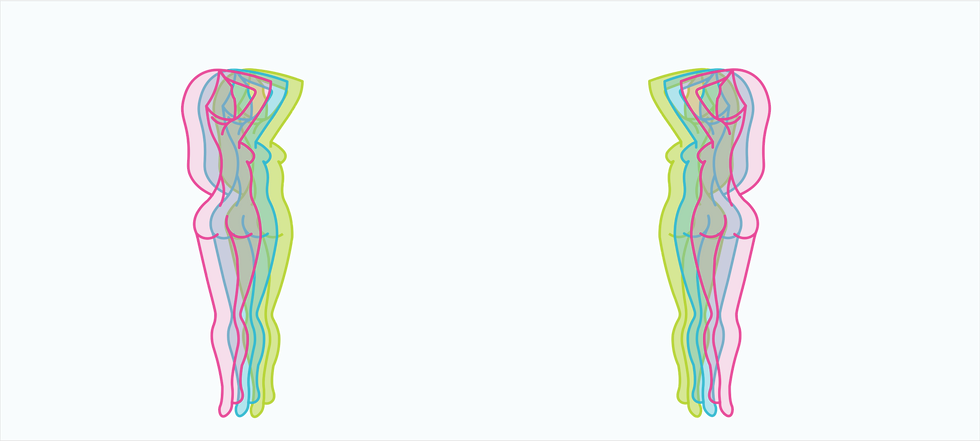
Now that I had the big design decisions out of the way, it was time to bring them across all of the deliverables of this project to create a cohesive visual identity. Once I started playing with the silhouette of the Slut- for female empowerment’s sake I’ll call her Karen- on the event poster, I wanted to use Karen on just about everything. I kept her off of the business cards simply because they would be used independently from the actual Slut Walk event. I loved the look of her posing with her feminine prowess on the event poster, but sitting pensively on the post card and tote bag. I challenge you to find me a sex kitten that doesn’t need a break every once in a while. I’ll wait.

Many people assume that design only applies to things like color choice and illustrations, but design is also carried through the narrative and written portion of any project. That’s why certain commercials just stick with you, they were crafted by a stellar group of writers to do just that. I was able to use my edgy comedic style in this project, which I effing LOVED. I mean, I had ample room to poke fun at all things casual sex while crafting my Slut Walk tote bag. I wear it all the time and get a huge kick out of watching people crack a smile when they read it. I think my personal voice really shined through the iPhone app design.

Throughout the design process I was in and out of the “testing” phase where you return your designs to the users for feedback. Luckily, I was constantly surrounded by a classroom full of hip youngsters that provided valuable feedback like “The slut’s back leg looks wonky” “Try a brighter shade of blue” “Is the slut supposed to look like you? Because it totally doesn’t.” I think my favorite part of the “testing” phase was hearing Jeanette’s thick Danish accent tell me that she thought my “sloot” might get cold during harsh Danish winters.
The final phase of the design thinking process is the “implement” phase. This is where you use your researched and tested design elements in fun and interesting ways. For instance, I liked how playful the three core shapes that made up my logo looked when made into a pattern, so I used that pattern on the business cards. I also created the logo to look like a neon sign for use on the event post card. The playful logo shapes were also used on the more conservative side of the tote bag design to create Copenhagen’s airport code of CPH. I think I had the most fun making the collection of stickers because they didn’t have to be bogged down with informational text. I took this opportunity to really create things that I would be excited to stick on my own laptop.

LOGO
JUDGEMENT DAY

While I knew that I was taking a real design chance with my bold and colorful concept, it all came down the final design presentations. One tough design instructor came in to judge our final work, and the whole class was shaking in their boots in anticipation of her harsh criticism. We had heard her make numerous students storm out of the classroom in tears just days before our final presentations, so naturally we were scared shitless. I made it through the formal presentation of my work without a hitch and turned to face the tough critic. I felt like an American Idol contestant anxiously awaiting Simon Cowell’s harsh words. To my surprise, she uttered “Well, it’s not my taste. But it solves the problem at hand and I instantly know that this is your work. Well done.” That’s the best I could have hoped for coming from the harshest critic I’ve ever encountered.
From one creative to another, here’s what getting hands-on with the design thinking process really taught me. Research is your best friend. Without it, there is no problem to solve and no solution for you to design. Don’t let roadblocks fluster you. Facing small challenges along the way will lead to the best product in the end.
Let your voice and style shine through! Choosing to incorporate elements that actually inspire you will make your hard work feel like fun instead of a chore. In the end, if you really let these golden nuggets of design thinking drive your creative process, you’ll end up with great projects that reflect your design style and ultimately provide a creative solution.